Close

Civic Education is the Civic Technology We Need Most

This essay was submitted to National Academies’ Idea Competition for Symposium on Imagining the Future of Undergraduate STEM Education. You can download a PDF version of this essay here.


Civic technology is an amplifier. It amplifies democracy by applying technology.

Democracy × TechnologyCivic

The technology part of this equation has been doing pretty well. Technology keeps advancing, making certain things easier and more efficient. There are also exciting movements in technology meant to instill public purpose among technologists. Code for America followed by the United States Digital Service and 18F have provided an outlet for technologists eager to build technology that allows governments to be more effective and accountable to citizens. Public Interest Technology, advanced by several prominent foundations, offers a framework for encouraging STEM professionals to engage in politics and policy and more broadly find their bearings by serving the public interest. The National Academy of Engineering’s Grand Challenges Scholars Program seeks to enlarge the definition of the competencies STEM graduates need in order to tackle the world’s most difficult challenges. I celebrate these movements and participate in them.

The democracy part of the equation has been struggling. There is low trust in democratic institutions around the world. Surveys show declines in young people believing that living in a democracy is essential.1 There are also long standing crises in civic engagement at all levels of collective governance. Scholars and journalists have given various reasons for civic engagement’s decline: dwindling enrollments in informal organizations like bowling leagues, the rise of cable television and the internet, newfound awareness of corrupt and racist politicians and policies, and hyperpartisan politics touching every issue and locality. As threats to democracy mount, civic education as a component of primary, secondary, and higher education has gone missing in many schools or, where it still exists, represents antiquated notions of democracy and America.

We are failing to appreciate that civic education is our most important civic technology. While technologists working on civic projects often mean well and make helpful contributions, we will never recover our democracy or realize the true potential of civic technology if we don’t revitalize civic education.

A 2014 study of engineering students by sociologist Erin Cech finds evidence that the culture of engineering seems to weaken students’ beliefs in their professional.2 In 2020, a cascade of headlines points to ways digital technologies are threatening justice, privacy, and democracy, and the political battles over COVID-19 have exposed deep mistrust of experts in science and medicine. Between now and 2040, our need for civic-minded STEM graduates will only grow.

We need a civic professionalism movement anchored in transformative civic education curricula built inseparably into every undergraduate STEM program.

A revitalized civic education acknowledges fundamental shifts in society and democratic practice and expands its definition of where democracy starts—not with voting but with citizen cooperation. Civic education begins in childhood, but STEM professionals also need educational experiences that help them recognize their profound roles and responsibilities as citizens. We need to entwine technical literacy and civic literacy. We need civic professionals in STEM, who think first as citizens, practice their profession in deeply democratic ways, and build civic technology as expressions of the identities they have developed through years of civic education.

Democratic educator Harry Boyte has written and advocated for constructing professional identities like the “citizen engineer,” an engineer who acknowledges the public dimensions of their work, not separating their citizen identity from their engineer identity.3 Democratic theorist Albert Dzur gives us the idea of “democratic professionalism” as power sharing.4 Civic professionals embrace multiple forms of expertise, complementing their specialized skills with the unique experiences of fellow citizens to solve difficult problems. These open and accountable collaborations build public trust in professionals through mutual respect and shared struggle.

Civic professionals must also learn to embrace the political dimensions of their work, acknowledging the ways that technical work is always situated in particular contexts and depends on certain structures and policies that serve some ideas, people, and outcomes well and others poorly. Cech’s research with higher education professional Heidi Sherick has found depoliticization of work to be one of the problematic pillars of engineering culture.5 Science and engineering are not cleanly separable from the rest of society. That mindset robs our democracy of STEM’s public purpose and accountability. Instead, civic professionals should aspire toward what Boyte calls “public work,” committing to models of co-creation, joint problem solving, and shared ownership.6 Public work binds us together in our shared citizenship and represents the foundational elements of democracy as a project of collective governance.

Education scholar Carolin Kreber envisions forging civic professional identities through transformative experiences in undergraduate education.7 A transformative STEM civic education is action-oriented and community-engaged, forcing us to challenge and revise our assumptions, values, and identities. It asks students to practice their profession in partnership with the public at the beginning of their training. Working with citizens outside of the classroom helps cultivate civic-mindedness. A civic professional’s new competencies include being able to frame a complex problem in partnership with community members who may not possess technical knowledge but whose lived experiences lead to the right questions and priorities necessary to setting a research and design agenda.

This is the future of STEM education our world needs most, reclaiming the public purpose of higher education and rebuilding trust in professions. During the next 20 years, society will continue to ask STEM graduates and the technology they create to solve its thorniest challenges. We need civic professionals in STEM who understand and identify with a much deeper sense of their public purpose, who are prepared to amplify our collective effort as citizens.

  1. Foa, Roberto Stefan, and Yascha Mounk. 2017. “The Signs of Deconsolidation.” Journal of Democracy​ 28 (1): 5–16.
  2. Cech, Erin A. 2014. “Culture of Disengagement in Engineering Education?” Science, Technology, & Human Values​ 39 (1): 42–72.
  3. Boyte, Harry. 2008. The Citizen Solution: How You Can Make A Difference​. Saint Paul: Minnesota Historical Society Press.
  4. Dzur, Albert W. 2010. Democratic Professionalism: Citizen Participation and the Reconstruction of Professional Ethics, Identity, and Practice.University Park, PA: Penn State University Press. Dzur, Albert. 2018. Democracy Inside: Participatory Innovation in Unlikely Places.New York: Oxford University Press.
  5. Cech, Erin A., and Heidi M. Sherick. 2015. “Depoliticization and the Structure of Engineering Education.” In ​International Perspectives on Engineering Education: Engineering Education and Practice in Context, Volume 1​, edited by Steen Hyldgaard Christensen, Christelle Didier, Andrew Jamison, Martin Meganck, Carl Mitcham, and Byron Newberry, 203–16. Philosophy of Engineering and Technology. Cham: Springer International Publishing.
  6. Boyte, Harry. 2004. Everyday Politics: Reconnecting Citizens and Public Life.Philadelphia: University of Pennsylvania Press.
  7. Kreber, Carolin. 2016. Educating for Civic-Mindedness.New York: Routledge.

Race After Technology book review

Race After Technology: Abolitionist Tools for the New Jim Code

Race After Technology: Abolitionist Tools for the New Jim Code by Ruha Benjamin
My rating: 5 of 5 stars

In Race After Technology, Ruha Benjamin delivers a powerful synthesis of STS and critical race theory. She diagnoses a series of problems plaguing the creation and effect of design and technology, drawing throughlines from historical through contemporary examples. If pressed for time, the lengthy introduction chapter summarizes her core argument both about the existence of the “New Jim Code” and need for abolitionist tools to dismantle it and the need for analyses and lens like she offers in this book that bring together STS and critical race theory.

She offers us four dimensions to the New Jim Code: engineered inequity, default discrimination, coded exposure, and technological benevolence/beneficence, each of which is described in Chapters 1-4, respectively. As she summarizes on page 47 of the Introduction: 1) “engineered inequity explicitly works to amplify social hierarchies that are based on race, class, and gender and how the debate regarding ‘racist robots’ is framed in popular discourse”; 2) “default discrimination grows out of design processes that ignore social cleavages” and when “tech developers do not attend to the social and historical context of their work”; 3) coded exposure is about the ways that technologies enable differential visibility and surveillance that often fall along racial lines; and 4) technological benevolence interrogates the problematic efforts and claims of “tech products and services that offer fixes for social bias.”

In her last chapter, Benjamin tries to imagine what an abolitionist toolkit would require to address the New Jim Code. As primarily a book of theoretical synthesis, her toolkit leans heavily on other frameworks like the Design Justice principles and the recommendations Virginia Eubanks articulates in her essential book Automating Inequality, also it celebrates the work of those developing approaches for auditing technology like algorithms. The key work done by the last chapter though is articulating the need for new “social imaginaries.” Building on the work of Black science fiction writers, Black new feminist theory, and the prophetic speech tradition integral to the Civil Rights Movement (think “I have a dream”), Benjamin’s call for abolitionist and liberatory design and technology is one of narrative. What is the future we want to live in and how do we describe it to ourselves and those around us? How do we see ourselves bringing that future into being? How do we dramatically redefine or expand our efforts of inclusion in design practices and the expansion of who is called a “designer” to those situated in society in ways and with expertise not usually invited explicitly or implicitly into design?

While this is definitely a scholarly manuscript, it reads easily and quickly for social theory. If you are working in the areas of UX design/research, AI, tech ethics, tech criticism, technology and politics, or race and technology, this is going to be essential reading. I expect to be recommending this to my engineering students for years to come.

View all my reviews

Design sprint workshop at TICTeC at the OECD in Paris

Designing Social Impact Metrics for Civic Technology

by Alisa Zomer, Erhardt Graeff, and Kelly Zhang

Bringing together partners from the US (POPVOX) and South Africa (Grassroot), we tested a new format to co-develop metrics and civic technology in an iterative design process.

This year’s largest civic technology gathering of practitioners and researchers (#TICTeC) took a hard look at the state of civic technology (i.e. Are we now in the fourth wave? Is it a sea change movement or has civic tech lost its relevance?). Focusing on questions of measuring impact, our team, including Erhardt Graeff from Olin College and Alisa Zomer and Kelly Zhang from MIT GOV/LAB, put together a design sprint workshop with partners POPVOX (U.S) and Grassroot (South Africa). The aim of our session was to kick-start an iterative design process to integrate social impact metrics into platform design from the very beginning, not as afterthought.

What does this mean in practice?

Erhardt Graeff at TICTeC 2019
Erhardt Graeff at TICTeC 2019.

As Erhardt discussed in recent work, impact for civic technology is often measured using basic descriptive data from the platform itself, including number of users, repeat users, time spent on the platform, etc.; however, these engagement metrics mostly fail to speak to the social impact goals at the heart of civic technology. In some cases, surveys are conducted where users rate their experiences on a platform, which can be helpful for troubleshooting user experience design problems. But answering the real question of social impact (i.e. has the platform changed outcomes, either beliefs or behavior) demands a different kind of metric.

In our workshop, we introduced an approach that starts by articulating what change you want to see—do you want to empower ordinary citizens to take a particular action (e.g., petition, protest, vote)? Or, do you want to see local government have a specific response (e.g., budget allocation, new legislation, improved service provision)?

Depending on the intended change, there is often relevant research to help in the design process. A wealth of research exists on what incentivizes or prevents citizens from engaging with their government, how to build strong grassroots movements, and also what barriers or opportunities present on the government side. Building on this knowledge, our goal is to bridge theory with design in a way that aligns with achieving and measuring social impact.  

For POPVOX, a platform to improve dialogue between citizens and government in the US, they ask: How might we measure participants’ understanding of government processes, comfort engaging, and sense that their voice matters? One approach taken by Erhardt previously is to measure perceived political efficacy (or the belief that you can influence or affect political change) in his work with SeeClickFix. He adapted a number of oft-used national survey questions for internal and external political efficacy to examine the context of city residents requesting their local governments fix the things they care about, finding correlations between government responsiveness on the platform and active users’ perceptions that their local governments were listening to them.

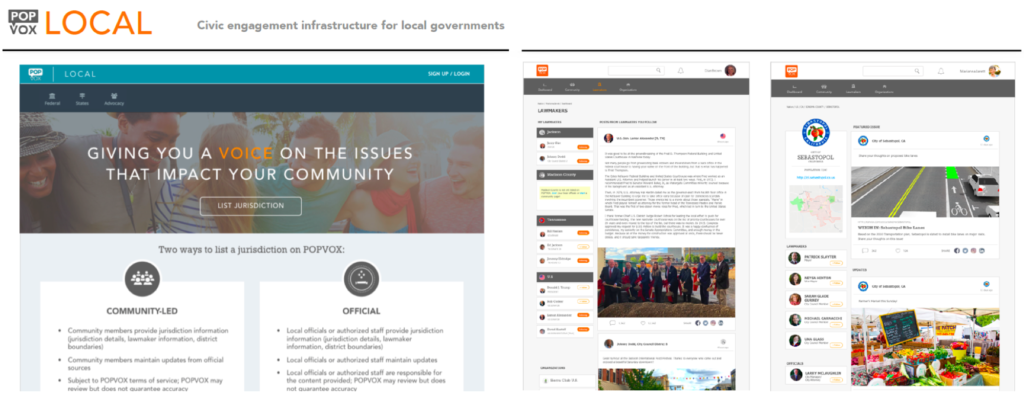
Screenshots from Marci Harris’s presentation on POPVOX’s platform
Screenshots from Marci Harris’s presentation on POPVOX’s platform.

Grassroot, which provides low-tech, low-cost tools for grassroots organizers working primarily with low income groups in South Africa, posed the following: How might we measure the ways in which social movement organizations grow and build capacity? Their main design constraints include a consistently unresponsive government and social movement organizations that have strong initial momentum but then steeply decline.

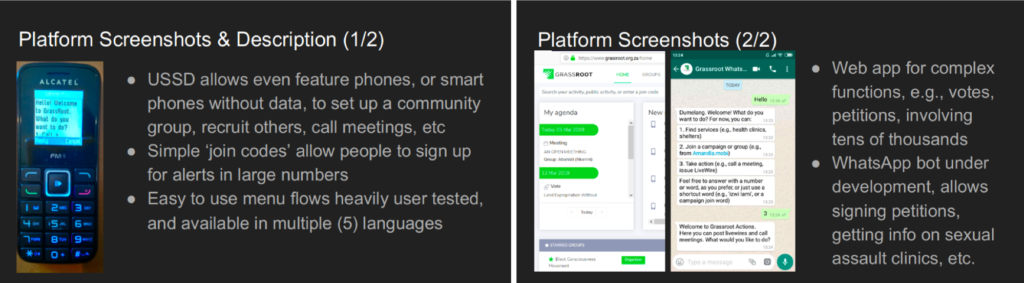
Screenshots from Luke Jordan’s presentation on Grassroot’s platform
Screenshots from Luke Jordan’s presentation on Grassroot’s platform.

Dividing into small groups, we tackled these design prompts to come up with relevant and feasible metrics, explain why they matter, and what data would be needed to measure them.

Sprinting for impact

Design sprinting in 70 minutes is not for the faint of heart, but we forewarned participants and the end results were a good start to a longer process. For Grassroot, some of the suggestions included looking at leadership development within organizations over time, assessing media visibility as a proxy for reach outside the movement, and measuring interactions between organizers across multiple policy issues. For POPVOX, suggestions included design features that notified citizens when officials read comments in order to build in some measure or response and trust-building.

In the coming months, both teams plan to move these pilots forward, building on the outcomes of the TICTeC workshop.

Workshop descriptions and slides available online. For more information, contact the MIT GOV/LAB at mitgovlab@mit.edu or Erhardt Graeff at erhardt@erhardtgraeff.com.

All event photos from Brian David Films

This report is cross-posted at the MIT GOV/LAB blog.

Emergent Strategy book review

Emergent Strategy: Shaping Change, Changing WorldsEmergent Strategy: Shaping Change, Changing Worlds by Adrienne Maree Brown
My rating: 5 of 5 stars

This is a powerful book. Though still young, adrienne maree brown has evidently lived many lifetimes at the vanguard of contemporary social movements. And she has earned a lot of wisdom through tough trials, a world of mentors, and deep reflection and practice.

Part call to action, part self-help book, part memoir, part transformative justice toolkit, Emergent Strategy is as intersectional in its genre and dimensions as it is in its politics. And these overlapping qualities embrace the concept of “emergence” at the heart of its narrative.

brown quotes leadership guru Nick Obolensky’s definition, “emergence is the way complex systems and patterns arise out of a multiplicity of relatively simple interactions.” She combines this concept and the underlying examples of emergence and chaos theory from nature with stories of movement building and her own deep study of Octavia Butler’s science fiction. Butler demonstrates for brown a way to use “visionary fiction” to articulate a vision of the world in which we practice a strategy for survival that is radically inclusive, democratic, and cooperative, counter to the hierarchical, competitive, and militaristic articulations of post-apocalyptic societies that generally dominate such literature.

Sharing the stories of her own work as executive director of Ruckus Society, facilitator and organizational change strategist, doula, and dear friend and sister, brown illustrates the principles and protocols of emergent strategy: fractals (the relationship between small and large), intentional adaption (how we change), interdependence and decentralization (who we are and how we share), nonlinear and iterative (the pace and pathways of change), resilience (how we recover and transform), and creating more possibilities (how we move towards life). Having shared an early version of the book with colleagues, mentors, and friends, brown incorporates their wisdom and stories offered in response, which serves to strengthen and underline her arguments for how the personal and community capacities for emergent strategy can make the difference between growing movements and stifling them.

While there are several “how-to” sections to the book that offer specific “spells” for personal growth or tools for facilitation, Emergent Strategy is much more than a how-to guide and deserves to be read as a series of meditations. Really, this is a book about developing a visionary orientation. How can you change how you see the world and help those around you change how they see it? How can you build the relationships that make it possible for us to live and work together toward a better future? How can you be honest, humble, and willing to keep learning and practicing?

Too often activists and organizers are looking for tactics, when they need to be developing strategy. At the heart of organizing is the use of relationship-building to develop the capacity of individuals and communities to find a common ground strategy and make change when the moment demands it. The messy process that births a social movement is emergent strategy. While there has been a lot of terrific scholarship on social movements like the Civil Rights Movement, it’s still incredibly hard to put a finger on what makes something like that work—there is so much complexity. But our capacity to respond and iterate through that complex landscape and handle the chaos of real humans working at massive scales are skills we can develop intentionally. And perhaps the best starting point will be brown’s book—a must read for students of civic and political engagement.

View all my reviews

Talking to Strangers book review

Talking to Strangers: Anxieties of Citizenship since Brown v. Board of EducationTalking to Strangers: Anxieties of Citizenship since Brown v. Board of Education by Danielle S. Allen

My rating: 4 of 5 stars

In Talking to Strangers, political philosopher Danielle Allen diagnoses the persistent problem of interracial distrust in America as a problem of defining and realizing democratic citizenship, i.e. how we are meant to act within our democracy. This is something that our country struggles with from its founding but is brought out most strongly by the Civil Rights Movement. Allen tells the story of how we developed this collective anxiety, diving into the choices of language, philosophy, and values that have led us here.

Starting with the iconic 1957 photograph of Black high school student Elizabeth Eckford being cursed by a white woman in front of Central High School in Little Rock, Arkansas, Allen illustrates how the civil rights movement marked a change in the experience of democratic citizenship among Americans. Brown v. Board of Education and later the Civil Rights Act and Voting Rights Act upset a status quo preserving de facto and de jure White dominance. This represented a clear loss of power for Whites, especially in the South. The new law of the land demanded that Whites respect the rights of their fellow Black citizens and curb their deep-set norms of racial inequality. Arguing the Civil Rights Movement was effectively a civil war in the South, Allen suggests that social trust and political friendship at the core of democratic citizenship never recovered. Trust in the federal government declined after it was seen as usurping state and local control by Whites, and trust in fellow citizens declined as the polity was recast as the heterogenous and equal mix it was always meant to be.

In this same historical moment, Allen notes that the Pledge of Allegiance was revisited adding “under God” after “one nation,” emphasizing the idea of oneness. The success of this re-wording effort is more than just about religion, Allen argues, it put forward a strong vision of a homogeneous nation. (In the same way, the original pledge was developed to spur national identity during the rise of immigration in the 1890s.) Allen argues that the American predilection for oneness (cf. E Pluribus Unum) ultimately hurts the cause of democratic citizenship and interracial distrust. Because it matters “how democratic citizens imagine ‘the people’ of which they are a part” (p. 17). Customs and practices follow from this imagined body. Allen prefers “wholeness” as the metaphor we should be striving for because it allows for multiplicity, heterogeneity. The toxic reaction to Eckford’s attempt to attend her desegregated school illustrates a desire to reassert oneness.

Part the practice of citizenship as either oneness or wholeness is sacrifice. Voluntary sacrifice is a virtue of democratic citizenship. We give some of our liberty to the state for protection and accept policies and decisions that serve a majority we may not be a part of. To paint this picture in the age of oneness, Allen dives deeply into Ralph Ellison’s novel Invisible Man, reading its political philosophy as a meditation on Black political sacrifice. Eckford’s ordeal in Little Rock represents this same type of sacrifice. In her case, she gives her dignity in that moment to the cause of the larger civil rights movement. There is a long tradition of such sacrifice in the Black community. During Jim Crow, it took the form of subjugation to the domination of Whites. This is an involuntary sacrifice. In this form of citizenship, oneness is preserved through the unequal treatment of the minority. But as Allen argues, sacrifice should be seen as a virtue; it should be respected. A more just and productive form of democratic citizenship respects the sacrifices of others in a polity. Citizens in this case should let sacrifice be a guide to a more mindful politics; they should honor it by finding solutions that listen to the voice of the minority and seek justice for them too.

This is the foundation of trust and what Allen calls political friendship. She suggests that friendship should be our guide to what citizenship ought to look like. A friend would listen to another friend even though they don’t agree with them. A friend would consider their friend’s feelings and well-being when making a decision. When a citizen can generally count on another citizen to look out for their interests, this reciprocity is the foundation for social trust and for democracy. This requires that we change our cultural norms to embrace this ideal of citizenship. It also requires that we transform our institutions to enshrine this respect for the wholeness of our nation. Unfortunately, America has yet to change its norms and transform its institutions in the wake of the Civil Rights Movement. Instead, we have retreated to ideological, and in many cases geographical, enclaves and maintained or developed postures of lost oneness.

Between these bookends, Allen develops a cogent philosophical critique of the underpinnings of American democracy. She finds a fatal flaw in Hobbes’s formula for government of the people and goes back to the Greeks and to rehabilitate rhetoric from its ambivalent reputation. Across his various writings, Hobbes successfully diagnosed the problems of human nature and politics and even points to how a culture of reciprocity might aid the effort of political agreement (p. 97). However, his prescription for the Leviathan form of government oriented citizens toward the sovereign institution of the state rather than toward one another, which is clearly illustrated in the frontispiece from his publication, wherein citizens’ heads are turned toward the sovereign.

This conception of the people—subjugating their own power to the sovereign in the interest of security and stability—contrasts with a one of equal, empowered citizenship. In American democracy we imagine the will of the people arising from equitably powered citizens themselves rather than the unitary voice provided by monarch or court. Locke and the founding fathers rejected this form of the social compact in which the people are ruled by the sovereign, and instead adopted a system of limited government. However, the perfectibility of Hobbes’s system is still seductive in light of his social analysis that consensus of the multitude’s wills is impossible. For Hobbes, stability and security can be achieved through repression. Alternatively, the promise of American democracy is that popular engagement may secure trust between the multitude and the institutions of government. And most often we see this as being through pure rational discourse among equals.

At this point, Allen goes on to propose a possible antidote to distrust and Hobbes’s view of the people. She defends the art of rhetoric, following Aristotle’s rejection of Plato’s model of a perfectible republic, arguing for the fundamental imperfect nature of politics among individual citizens. In this, Allen also critiques of Habermas’s ideal of dispassionate, consensus-based political discourse. While having such a utopian vision is an important goal to strive toward, Allen notes that unanimity in consensus “idealizes the wrong thing and fails to establish evaluative criteria for a crucial democratic practice—the attempt to generate trust out of distrust” (p. 85).

Aristotle offers a favorable comparison between a rhetoric and medicine: “a doctor aims not only to cure as many patients as possible but also to treat properly ‘even those who recovery is impossible.’” “So, too, a rhetorician seeks not perfect consensus but maximal agreement coupled with satisfactory treatment of residual disagreement and those emotions in which it is often registered: anger, disappointment, and resentment” (p. 91). Allen concedes, that the utility of rhetoric can be used for good as well as for ill, just like medicine can be—the Greek debate over sophistry comes from concern over how rhetoric can exploit trust and distrust. However, without rhetoric we lack the foundation for an intersubjective experience of democracy—for reciprocity—whereby we consider the interests of others and appeal to both majority and minority, crafting our arguments through negotiation and affective feedback.

In practice, this is a citizenship of political friendship—an orientation toward each other, viewed as equals, and a willingness to empathize, to persuade, and to be persuaded. This also means an acknowledgement of histories of inequality and disempowerment, and an interest in pursuing a restoration of equity for our fellow citizens that can allow us to enjoy the wholeness of our nation. And Allen implores us to make this part of our everyday civic practice.

View all my reviews